|
Product Details:
|
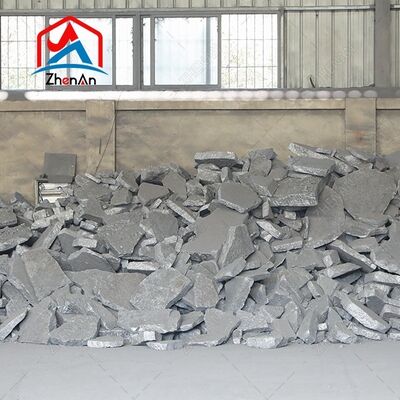
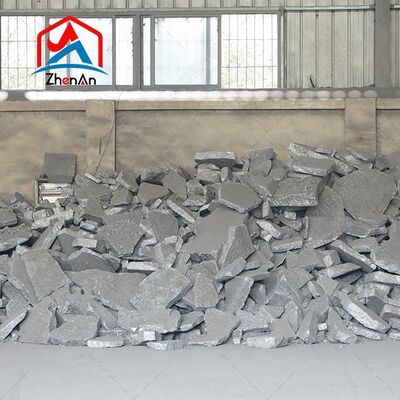
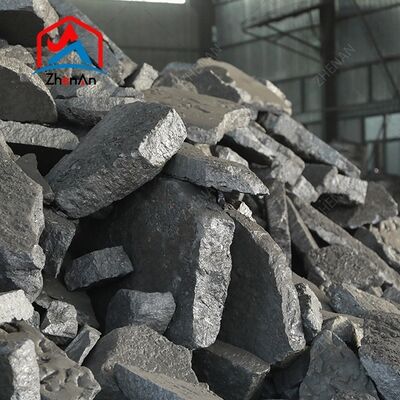
| Material: | Ferro Silicon Magnesium | Color: | Gray |
|---|---|---|---|
| Chemical Compostion: | Si Fe Al S P | Shape: | Lump |
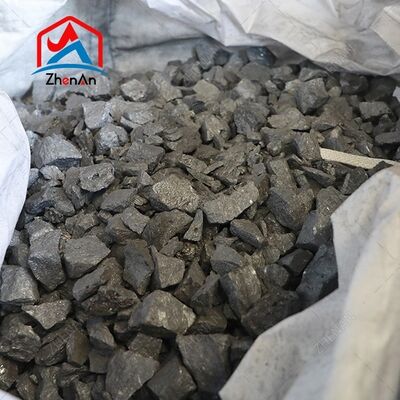
| Packing: | In 1MT Big Bags | Application: | Steel Making |
| Highlight: | FeSiMg alloy for ductile iron casting,Ferro Silicon Magnesium 5% 6% 7%,FeSiMg alloy for magnesium treatment |
||
Three magnesium levels exist because no single level covers every heat. A foundry treating thin sections in a small ladle is over-treating if it uses a 7% alloy; a plant pouring thick walls from a large ladle is under-treating with a 5%. The choice sits between two failures: too little magnesium leaves flake graphite and a scrap casting, while too much leaves shrinkage, dross and a hard, brittle structure that machining cannot rescue. FeSiMg alloy 5% 6% 7% gives the treatment station a way to move between those edges without changing alloy family, supplier or certificate format. ZhenAn supplies all three windows from the same published grade list, so a plant can compare them on chemistry rather than on brand claims.
The alloy dissolves into the iron rather than melting in it. Silicon lowers the melting point of the carrier so the lump breaks down at bath temperature, and the magnesium that is freed first goes to work on sulphur and oxygen. What remains becomes the residual that grows nodules during solidification. Two consequences follow. First, treatment is a race: alloy that sits on the bottom too long loses magnesium to the slag. Second, the fraction matters as much as the chemistry, because a coarse lump dissolves slowly and a fine granule burns at the surface.
In practice, 5% material is poured into small ladles and used within a short window, 6% material covers the middle of most shops, and 7% material is kept for heavy sections and slow pouring lines. Treatment itself is usually run at 1450–1470 °C; above 1500 °C the magnesium loss climbs sharply and the alloy weight has to be raised to compensate. Each level is packed in 25 kg bags or 1000 kg jumbo bags and shipped on pallets.
The grade table follows the GB/T 4138-2015 windows: magnesium at 4.0–6.0% for the 5% family, 5.0–7.0% for the 6% family and 6.0–8.0% for the 7% family. Silicon is stated as a 45.0% minimum, the floor the standard sets for this group, with normal delivery at 45–48% and a 38–44% window available to order. Calcium is 2.0–3.0% on the 5% and 6% grades and 1.0–3.5% across the 7% grades. Aluminium stays at or below 1.0%, and iron makes up the balance. Rare earth moves with the grade: 1.0–3.0% on FeSiMg5Re2, 0.5–1.5% on FeSiMg6Re1 and FeSiMg7Re1, and 2.0–4.0% on FeSiMg7Re3.
| Supply item | What the site states |
|---|---|
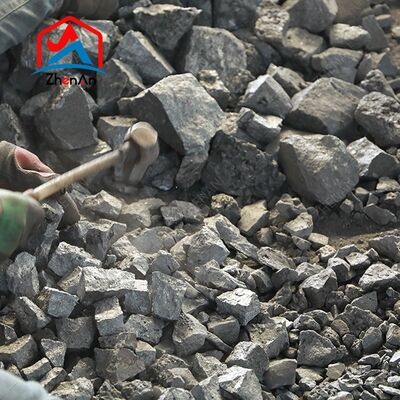
| Screened fractions | 0.25–2 mm, 1–5 mm, 5–20 mm, 10–30 mm, or to customer requirement |
| Bag options | Plastic woven bag, 1000 kg jumbo bag |
| Delivery | 7–14 days from receipt of advance payment |
| Minimum order | Negotiable |
Read the magnesium window as a band, not a promise of one number. Two lots both inside 5.0–7.0% can differ by a full point, and on a marginal heat that point decides whether the casting passes. That is why the lot certificate, not the grade name, is the document to file.
| Casting family | Level that usually fits | Reason |
|---|---|---|
| Thin-wall covers, brackets, small valve parts | 5% | Short pour, low section, less fade before the mould fills |
| General jobbing work, pump and motor housings | 6% | Balances reserve against over-treatment on mixed sections |
| Heavy frames, bases, counterweights | 7% | Longer solidification, more magnesium consumed before freezing |
| High-sulphur charge, oily returns | 7% with higher rare earth | Sulphur and tramp elements take magnesium before it can nodularize |
A shop that pours several families from one station should not force every heat through one level. Changing the bag is cheaper than scrapping a heat, and the certificate format stays the same across all three windows.
| Item | What to confirm | Why it matters |
|---|---|---|
| Magnesium window | The band the certificate must fall inside | Defines treatment response and residual |
| Fraction | Millimetres, plus accepted oversize | Controls dissolution rate and fines |
| Rare earth level | Re1 or Re3, stated on the certificate | Affects tramp element tolerance and price |
| Weight per bag | 25 kg or 1000 kg | Decides handling equipment at the bay |
| Tonnage and schedule | Per shipment and per year | Sets the production slot and freight plan |
| Documentation | Lot certificate and sampling method | Supports the receiving inspection |
Two items are often left off: the sampling method behind the certificate, and the size tolerance. A certificate drawn from a grab sample at the bag top does not describe the container, and a fraction described only as "lump" can arrive anywhere between 5 and 100 mm.
Not safely. The alloy weight, the plunge depth and the pour timing all assume a magnesium input. Recalculate the charge before the first production heat.
No. Nodule count depends on nucleation and cooling as much as on residual magnesium. Excess magnesium adds dross and shrinkage.
It assists deoxidation and helps the reaction settle. A certificate that omits calcium cannot be compared with the previous lot.
Weigh three bags, inspect the fracture, screen a sample and send a coupon for analysis. Record the results against the lot number.
A small share is normal after handling; a large share points to screening or storage problems.
Yes, with separate marked bags and separate certificates per level.
Send those three lines to sales@zaferroalloy.com, or reach the desk on WhatsApp +86 15518824805 when a trial heat is already scheduled. Expect a reply within one working day: the grade, the magnesium band the certificate will carry, and the first loading date after the deposit clears.
Contact Person: Mr. xie