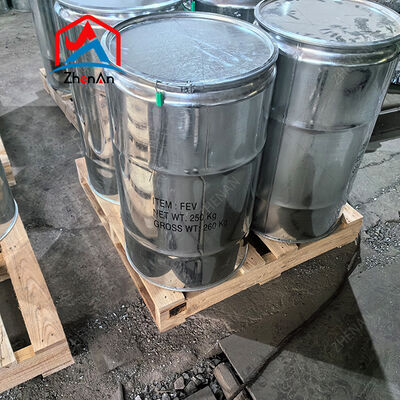
FeV Alloy Granules 50 Mesh Fine Grain Metallic Silver
FeV alloy granules (50 mesh, ~300 µm) in metallic silver represent a specialized form of ferrovanadium, optimized for high-strength alloy production where uniform distribution and rapid dissolution are critical. Finer than standard lumps or briquettes, these granules leverage their small particle size to accelerate melting and homogenization in molten metal baths, making them ideal for advanced alloys used in aerospace, defense, and energy sectors.
Their metallic silver sheen signals high purity, with minimal oxidation, ensuring predictable alloying outcomes. High-strength alloys, such as nickel-based superalloys or titanium aluminides, require precise control over elemental dispersion to achieve targeted mechanical properties (e.g., yield strength >1000 MPa, creep resistance at 800°C+).
FeV granules excel here: their 50-mesh fineness allows rapid dissolution, preventing localized vanadium enrichment that could cause brittle phases. Instead, vanadium integrates uniformly, forming nanoscale carbides and intermetallics that strengthen the matrix via dispersion hardening. This results in alloys with superior load-bearing capacity and resistance to cyclic stress—essential for jet engine components, turbine blades, and deep-sea pressure vessels.
Additional benefits of 50-mesh FeV granules include compatibility with powder metallurgy processes, where they can be blended with other alloy powders for net-shape manufacturing. Their low surface area-to-volume ratio reduces oxidation during storage, preserving reactivity.
Key Specifications
| Parameter |
Details |
| Vanadium Content |
40-60% (customizable; typical 50%) |
| Particle Size |
50 mesh (≤300 µm), 90% pass rate |
| Color |
Metallic silver, bright (oxidized surfaces exhibit pale grey tinge) |
| Key Properties |
High reactivity, low moisture absorption (<0.5%), free-flowing |
| Primary Applications |
Nickel-based superalloys (Inconel 718), titanium alloys (Ti-6Al-4V), armor plating |
By enabling precise microstructural engineering, FeV granules empower manufacturers to push the boundaries of alloy performance. Their adaptability to both liquid-phase and solid-state processing positions them as a versatile solution for next-generation high-strength materials, aligning with trends toward lighter, more resilient infrastructure and technology.
Ferro Vanadium FeV Composition (%)
| Grade |
V |
Al |
P |
Si |
C |
| FeV40-A |
38-45 |
1.5 |
0.09 |
2.00 |
0.60 |
| FeV40-B |
38-45 |
2.0 |
0.15 |
3.00 |
0.80 |
| FeV50-A |
48-55 |
1.5 |
0.07 |
2.00 |
0.40 |
| FeV50-B |
48-55 |
2.0 |
0.10 |
2.50 |
0.60 |
| FeV60-A |
58-65 |
1.5 |
0.06 |
2.00 |
0.40 |
| FeV60-B |
58-65 |
2.0 |
0.10 |
2.50 |
0.60 |
| FeV80-A |
78-82 |
1.5 |
0.05 |
1.50 |
0.15 |
| FeV80-B |
78-82 |
2.0 |
0.06 |
1.50 |
0.20 |

Packing & Delivery
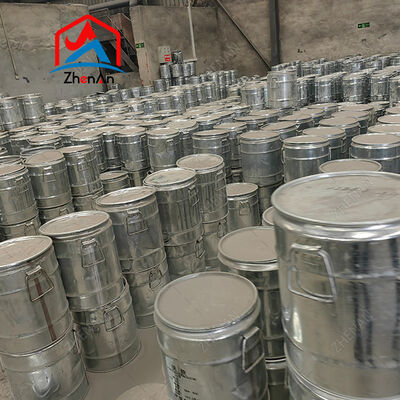
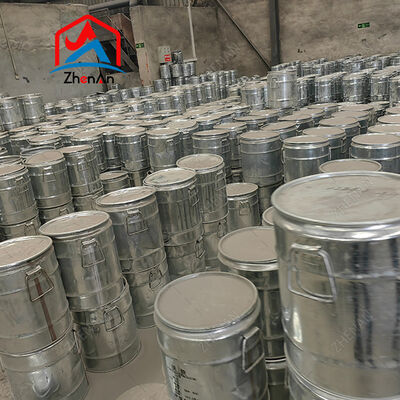
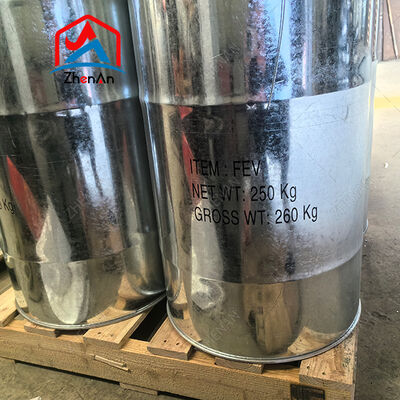
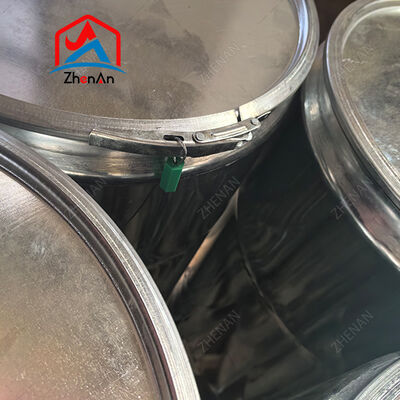
Packing: 1 ton big bag, 20-25mt in 20' container
Company Profile
ZHENAN has been in the business of ferroalloy for 30 years now. It is a leading manufacturer and supplier of ferro silicon, silicon metal, silicon carbide, high carbon silicon and so on. Our company is a large-sized production enterprise integrating research, development, production and sales.
Frequently Asked Questions
Q: What is ferrovanadium?
A: Ferrovanadium is an iron-vanadium alloy used to add vanadium to steel.
Q: Ferrovanadium definition and uses?
A: It's an alloy of iron and vanadium; used to improve strength, toughness, and heat resistance in steel.
Q: Difference between ferrovanadium and vanadium metal?
A: Ferrovanadium contains iron; vanadium metal is pure vanadium.
Q: What types of ferrovanadium are there?
A: Common types: FeV40, FeV60, FeV80 (numbers indicate vanadium content).


 Your message must be between 20-3,000 characters!
 English